
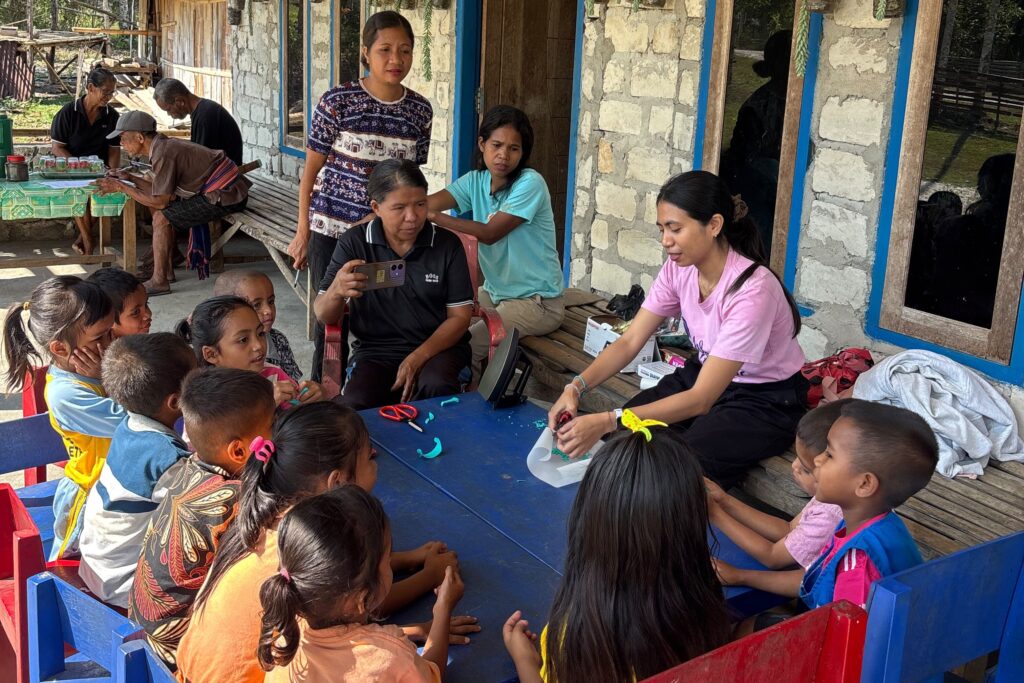
Pelatihan di PAUD Budi Kasih, Desa Legalete, Kab. Sumba Barat Daya (14 Oktober 2026)
East Nusa Tenggara (NTT) – A clean and healthy environment is one of the essential foundations for children’s growth and development and family well-being. However, household waste management remains a challenge in several rural areas, including Timor Tengah Selatan Regency and Southwest Sumba Regency in East Nusa Tenggara. Of the 3,308 villages in NTT, only 142 have reported waste management activities, according to 2023 data from Statistics Indonesia (BPS).
Improperly managed household waste can lead to various environmental and health problems. In response, Foundation for Mother and Child Indonesia (FMCH Indonesia), with support from Bank of America Merrill Lynch (BAML), facilitated community-based training on organic and inorganic waste management in its program areas across NTT from October to November 2026.
Turning Waste into Valuable Resources
Through the training, participants gained knowledge and hands-on experience in sorting and utilizing both organic and inorganic waste.
Inorganic waste, particularly plastic, was introduced as a material that can be repurposed through recycling and creative activities. Products developed during the training included ecobricks, keychains, and pouches. Through these activities, community members learned that plastic waste, which is often considered useless, can be transformed into functional products with potential economic value and income-generating opportunities.
Meanwhile, organic household waste, such as vegetable scraps, dry leaves, and other natural materials, can be processed into Bokashi fertilizer. This organic fertilizer can support more environmentally friendly agricultural activities and household gardening.
Reaching Early Childhood Education Centers in Two Regencies in NTT
In Timor Tengah Selatan Regency, the activities covered seven program villages: Anin, Mio, Nunleu, Fenun, Enoneten, Kokoi, and Nenoat. The training was conducted at ten early childhood education centers (PAUD): PAUD Sion, Mentari Kobekaka, St. Fransiskus, Fobonlunu, Lahairoi, Mahanaim, Sonhalan, Enobesa, Imanuel, and Lilin Kecil.
Meanwhile, in Southwest Sumba Regency, the training has been completed across seven program villages: Wee Rame, Lagalete, Denduk, Wee Londa, Pogo Tena, Kenduwela, and Kabalidana. The activities involved PAUD Bukit Zaitun, Budi Kasih, St. Gabriel, Hati Nurani, St. Maria Pakondawatu, Tunas Bangsa, and Pelita Kasih.
Using a community empowerment approach and hands-on learning methods, the activities engaged young children, parents, PAUD teachers and administrators, as well as village government representatives. This initiative is expected to expand waste management education by positioning early childhood education centers and families as key drivers of behavioral change within their communities.
The utilization of organic waste also provides families with an opportunity to develop home gardens where they can grow vegetables. This can help improve household food availability and support better maternal and child nutrition through a more diverse diet.
Therefore, waste management not only benefits the environment but also creates opportunities to strengthen household food security and family economic well-being.
Creating a Clean Environment to Support Maternal and Child Health
Beyond maintaining environmental cleanliness, proper waste management is also part of creating an environment that supports maternal and child health.
Young children and pregnant women are more vulnerable to the effects of unhealthy environmental conditions. Accumulated waste can attract flies and other disease-carrying insects, while polluted surroundings may increase the risk of health problems. Exposure to smoke from burning waste can also affect respiratory health in children and adults.
Women and mothers also play an important role in household management, including establishing clean and healthy habits for all family members. Therefore, improving community knowledge and skills in sorting and processing waste is expected to become part of everyday family health practices.